| |

We are pleased to invite you to the opening of
Bruce Davidson
Award-Winning Civil Rights Photographer
Friday, May 9, 2008
6:00-8:00 pm
Artist Talk
Saturday, May 10, 2008 - 11:00am
www.jacksonfineart.com
3115 East Shadowlawn Avenue
Atlanta, GA 30305
Show Dates: May 9 - July 5, 2008
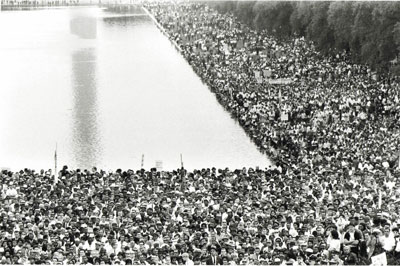
Jackson Fine Art is honored to present a selection of works by acclaimed Civil Rights photographer Bruce Davidson and includes pieces from Davidson's remarkable 1960s Time of Change and East 100th Street series.

The exhibition at Jackson Fine Art comes just one month before the High Museum opens "Road to Freedom: Photographs of the Civil Rights Movement, 1956 - 1968," an unforgettable exhibition curated by Julian Cox. "Road to Freedom" will be the most important art-museum exhibition devoted to Civil Rights photography in more than two decades. The High summer exhibition will include work from 20 photographers, Davidson among them with 15 pieces from Time of Change featured.
|
 |
|
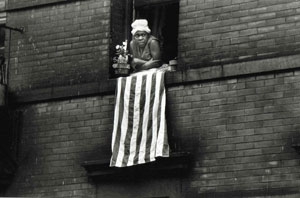 |
Davidson's much-lauded Time of Change series developed during four years he spent documenting the Civil Rights Movement in locations from Alabama to New York City. Rather than simply reifying the negative aspects of the years 1961 - 1965, Davidson's images display a sense of community and strength.
|
 |
|
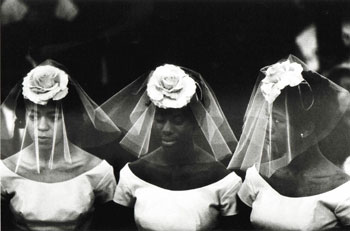
Davidson reminds us that people lived lives - from heroic to simple - during those turbulent years. In the series, he examines ritual, work, home and family, challenging viewers to reinterpret historical knowledge and imaginings. Davidson's photographs take us beyond the surface of the Civil Rights story, according to Deborah Willis. "As he chronicled these moments, he was acting as both participant and observer." |
We are given an expanded impression of the Civil Rights Movement. Images like women in fur stoles at a formal social event or children studying in a dilapidated schoolhouse promote humanity, while others like one depicting three women in a bedroom surrounding a portrait of John F. Kennedy impart a sense of irony.
Following his recording of the Civil Rights Movement, Davidson was awarded the first grant in photography from the National Endowment for the Arts in 1966. He spent the next two years documenting one block in East Harlem, a series that became East 100th Street and was published in 1970. |
|
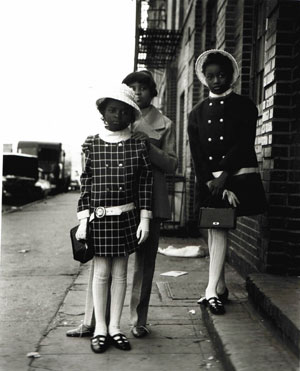 |
Davidson explains that while working on the series, his idea of "home" became "an old man who grows grass between broken slabs of concrete in a tenement backyard, children behind windows covered by chicken wire, walls with pictures of Christ, Kennedy, and the American flag, and a retired maid in uniform scrubbing her own linoleum floor." Rather than turning the neighborhood residents into objects or even objects of pity, Davidson shows them as humans with determination to survive and create life within tough economic and social circumstances. In Davidson's images, the subjects become agents in their own life making.
 |
|
 |
Bruce Davidson's passion for photography began in Oak Park, Illinois at the age of 10. He attended Rochester Institute of Technology and Yale University before being drafted into the army. While stationed in Paris, he met Magnum Photos co-founder Henri Cartier-Bresson. During the late 1950s, Davidson worked as a freelance photographer for LIFE magazine and became a full member of Magnum Photos. He created important series including "The Dwarf," "Brooklyn Gang" and "Freedom Rides" before receiving a Guggenheim Fellowship in 1962 to photograph the Civil Rights Movement. The following year, Davidson was honored with a solo show at the Museum of Modern Art in New York. Since the 1960s, he has continued to earn recognition for his work including the Lucie Award for Outstanding Achievement in Documentary Photography in 2004. Davidson's well-known series comprise more than 15 books including East 100th Street, Portraits and Time of Change, Civil Rights Photographs 1961-1965. His work has also been exhibited in The International Center of Photography in New York, The Walker Art Center in Minneapolis, the Smithsonian Institution, The Parco Gallery in Tokyo and The New-York Historical Society and a solo exhibition at the Henri Cartier Bresson Foundation in Paris, 2007.
Jackson Fine Art is located at 3115 East Shadowlawn Avenue. Gallery hours are Tuesday - Saturday from 10-5pm. For more information and image files, please contact Malia Stewart at malia@jacksonfineart.com.
|
|
